There's a moment most senior leaders recognize, even if they don't talk about it openly. The calendar is full, the decisions keep coming, and somewhere around month eight of a brutal fiscal year, the person making those decisions starts running on fumes. Not metaphorically. Actually running on fumes, skipping sleep, canceling workouts, eating airport food at 11pm. That's when the question stops being "can we afford a leadership retreat?" and becomes "can we afford not to do this?"
Executive wellness retreats aren't spa weekends with a strategy session bolted on. The best ones are purpose-built environments where the work of leadership renewal happens in a structured, intentional way, and where the physical, mental, and relational dimensions of performance actually get addressed together.
This guide covers where to go, what to look for, and how to structure a wellness-focused executive retreat that your team will actually remember.
Why Wellness Has to Be the Core, Not the Add-On
Most corporate retreats get wellness backward. They schedule a yoga class at 7am on day two, put a fruit bowl in the conference room, and call it a health-conscious agenda. The leadership team spends six hours in a windowless room running through slides, then drinks too much at the welcome dinner and does it all again the next morning.
That model doesn't work (and honestly, that's the whole point of rethinking it entirely). Real recovery and real renewal require more than a token gesture. They require building the program around rest, movement, and reflection first, and letting the strategy conversations emerge from that foundation.
The best executive health retreat programs flip the schedule. Morning sessions start with movement or meditation. Meals are long and slow, eaten without phones. Afternoons include structured reflection time, not just breakout sessions. The evenings are quiet enough to think.
Destinations That Actually Deliver
Geography matters more than most people admit. The right setting does some of the work for you. Here are specific destinations worth serious consideration.
Tuscany, Italy - Borgo Santo Pietro
The property sits in the Val d'Orcia, about 40 minutes south of Siena, and it's been quietly hosting private groups for years. What makes it work for executive wellness retreats isn't the Michelin-starred kitchen or the biodynamic farm, though those don't hurt. It's the pace the place imposes on you. You can't rush here. The roads are winding, the meals take two hours, the staff moves at a rhythm that feels almost deliberately unhurried.
Programs for leadership groups can be built around the property's wellness center, which offers sleep coaching, thermal pools, and daily bodywork. The kitchen team will design menus around whatever your group needs, whether that's gut health, energy management, or just vegetables that taste like vegetables again. You can run strategy sessions in the morning, then spend the afternoon walking the estate's olive groves before a group dinner that stretches past 10pm in the Italian way.
Speaking of which, if your group is heading to Italy, it's worth understanding how the Italian meal actually functions before you arrive. The article How People Eat Together in Italy: Pace, Presence, and Unspoken Signals breaks down the timing, the silences, and the unspoken rules that structure shared eating. Understanding that context will change how your team uses mealtimes, which in a wellness-focused retreat is actually significant.
Arizona, USA - Miraval Resort, Wickenburg Ranch, and Canyon Ranch
Arizona has developed a serious concentration of executive health retreat infrastructure, and for good reason. The desert environment itself has measurable effects on stress physiology. The light is different. The silence is different. There's something about 360-degree sky that recalibrates your nervous system in ways that a mountain forest doesn't quite replicate.
Miraval Arizona outside Tucson is probably the most well-known option. They've been running executive group programs since the late 1990s, and the programming reflects that experience. The equine therapy component is genuinely useful for leadership development work, not as a novelty but as a real diagnostic tool for how people communicate and lead under pressure. Groups that do the horse work together often report that it surfaces dynamics in 45 minutes that team-building facilitators spend days trying to reach.
Canyon Ranch, also in Tucson, takes a more clinical approach. Medical assessments, sleep studies, VO2 max testing, detailed biomarker panels. If your group includes leaders who are genuinely concerned about their health and want data to work with, Canyon Ranch gives them that framework. It's less "retreat" and more "performance medicine," which suits certain executive cultures better than others.
Wickenburg Ranch, about 90 minutes north of Phoenix, is smaller and less structured. Worth considering if your group wants privacy and doesn't need a full program handed to them.
Scotland - Gleneagles Hotel, Perthshire
Gleneagles has hosted heads of state and G8 summits, so the security and privacy infrastructure is already there. But it's the landscape of Perthshire that does the real work. The Ochil Hills, the moorland, the cold air, the walking. A guided hill walk in the morning followed by a proper lunch and an afternoon in the spa is a genuinely restorative rhythm, and it's one Gleneagles has down to a science.
The hotel's Retreat spa is one of the better executive wellness facilities in Europe, and they'll work with your team to design programs that include everything from thermal bathing to forest bathing to sleep optimization workshops. The golf is world-class if that matters to your group, but it's not required. Gleneagles works just as well for a team that wants to walk, eat well, and think slowly for four days.
Japan - Ryokan Retreats in Kyoto Prefecture and Hakone
This one requires more planning, but the ROI is real. Japanese ryokan culture is essentially built around the principles that executive wellness retreats try to recreate: simplicity, ritual, rest, natural materials, food that's considered rather than convenient. The onsen bathing tradition, the multi-course kaiseki meals, the tatami rooms, the silence. It all adds up.
For executive groups, a curated ryokan circuit can work beautifully. Three nights at Beniya Mukayu in Yamanaka Onsen, then two nights at Gora Kadan in Hakone. Both properties accommodate private dining and meeting space, and both can connect you with facilitators who work specifically with international leadership groups. The cultural dislocation of being in Japan, the fact that your team can't just default to their normal patterns, is actually useful. It breaks the autopilot.
New Zealand - Mahu Whenua, Otago
For groups willing to travel, Mahu Whenua outside Queenstown is almost unfairly good. The private wilderness retreat covers roughly 34,000 acres, which means your group of 12 leaders is genuinely alone in a way that's almost impossible to find elsewhere. Helicopter access, private chef, a full wellness team that comes to you. You can design the program from scratch, which requires more work upfront but gives you complete control over the balance between activity and rest.
Program Architecture: What to Actually Put on the Schedule
The destination matters, but the program structure is where most executive wellness retreats succeed or fail. Here's what works.
Day One: Arrive and Decompress
Don't schedule anything substantive on arrival day. This sounds obvious. It isn't, because someone will always want to use that first evening for a "light intro session" or a "quick alignment conversation." Resist that. People are traveling from different time zones, different stress loads, different states of mind. Give them a welcome dinner, a walk, maybe a short orientation to the space. That's it.
The temptation to maximize every hour is exactly the pattern you're trying to interrupt.
Days Two and Three: The Core Program
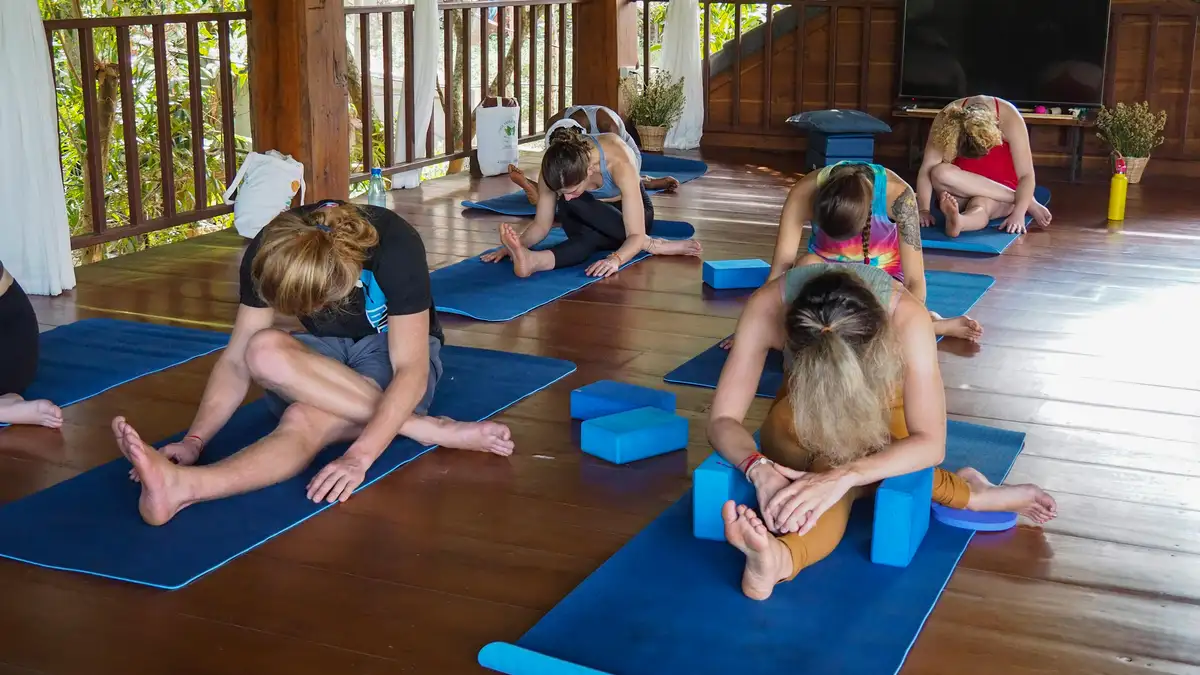
Morning movement should be non-negotiable. Not a choice between movement and sleeping in. Movement. Whether that's a guided hike, a yoga session, cold water immersion, or a swim, the morning needs to include something physical that isn't optional. This is the part where some executives will push back, and it's the part that matters most.
Breakfast should be long. An hour minimum, eaten together, with phones left in rooms. This is harder to enforce than it sounds, and it's worth being explicit about the expectation before the retreat begins.
Morning sessions, if you're running leadership programming, should focus on reflection and input rather than decisions and output. Guest speakers, structured journaling, facilitated conversations about vision and values. Keep the room size small enough that everyone can speak.
Afternoons are for individual wellness programming. This is where the biomarker assessments, the bodywork, the one-on-one coaching conversations, and the personal downtime happen. Two to three hours of unscheduled time in the middle of the day feels almost illegal to most executives. That's exactly why it's valuable.
Evening dinners should be the social anchor of each day. Long, unhurried, good food, and a topic of conversation that isn't work. The best retreats I've seen structure these around a single question dropped into the table at the start, something like "what's a moment from your career that you're still learning from?" and then let the conversation go where it goes.
Day Four: Integration and Forward Planning
The last day is where you bring it back to the organizational context. What have people noticed about themselves? What patterns came up? What does the team need from each other in the next quarter? This is also when you can do the strategic planning that some stakeholders will insist needs to be on the agenda.
But keep it to half a day. Maximum.
The Wellness Programming That Actually Moves the Needle
Not all wellness programming is created equal in the executive context. Here's what tends to have lasting impact versus what tends to be forgotten by the return flight.
Sleep optimization work has the highest ROI of almost anything you can offer a senior leadership group. Most executives are sleeping poorly and have normalized it. A structured sleep assessment, combined with education around sleep architecture and practical protocol changes, often produces immediate and measurable results. Canyon Ranch and Miraval both have serious sleep programs. So does SHA Wellness Clinic in Alicante, Spain, if you want a European option.
Physiological testing matters to a certain kind of leader. Give them data about their cortisol patterns, their HRV, their metabolic markers, and they'll engage with the wellness programming the same way they engage with a P&L. It makes the abstract concrete. This approach works particularly well with finance, engineering, and operations executives who find the softer elements of a retreat harder to value.
Somatic work is having a moment in executive wellness, and for good reason. Leaders who carry chronic stress in their bodies often discover, in a session with a skilled practitioner, that they've been operating with a level of physical tension they'd completely stopped noticing. Craniosacral therapy, Rolfing, trauma-informed yoga, breathwork. These modalities aren't for everyone, but for the right people they produce genuine shifts in how they feel and function.
Group therapy-adjacent facilitation is worth considering for leadership teams that are navigating real tension or transition. Not quite therapy, but structured conversations with a skilled facilitator who can help the group surface what's actually going on beneath the professional surface. Retreats that include this kind of work often get described, years later, as turning points.
What to Look for in a Retreat Venue
The checklist is shorter than you'd think.
Privacy. Your executives need to be able to exist without being recognized, observed, or approached by other guests. This means either a fully private property or a venue that can guarantee exclusive-use arrangements.
Outdoor access. This is non-negotiable for a wellness-focused retreat. Walking trails, water, open sky. Something that gets people outside and away from screens for at least a few hours each day.
Food that's actually good. Not just healthy. Good. There's a version of retreat food that's virtuous and joyless, full of quinoa and unseasoned proteins. That's not what you want. You want a kitchen that can make clean, beautiful food that people genuinely look forward to eating. Borgo Santo Pietro in Tuscany, Gleneagles in Scotland, and the better ryokan in Japan all clear this bar easily.
Connectivity options. You'll need reliable wifi for the inevitable urgent situations, but you also need the option to truly disconnect. The best venues have wifi available but don't broadcast it aggressively. It should require a choice to connect, not a choice to disconnect.
The Facilitation Question
Who runs the program matters as much as where you run it. An executive wellness retreat with no skilled facilitation is just an expensive vacation, which might be fine for some groups but probably isn't what you're paying for.
Look for facilitators who have worked specifically with senior leadership groups, not general corporate audiences. The dynamics are different. The resistance is different. The ego investment is different. Facilitators who work primarily with mid-level teams often find themselves under-equipped for a room full of C-suite executives who are used to being the smartest person in the room.
The best facilitators for this work have usually had careers outside facilitation first. Former executives who went deep into mindfulness or somatic work. Therapists who crossed over into organizational consulting. Coaches who've done serious personal development work themselves. You're looking for someone who can hold their own in a conversation about market dynamics and then pivot to asking a CEO why they haven't cried in four years.
That person exists. They're worth finding.
Budgeting: What This Actually Costs
Be honest with yourself about the numbers upfront.
A well-designed executive wellness retreat for a group of 10-15 leaders, running four days at a quality destination, will typically run somewhere between $3,000 and $8,000 per person per day, all-in. That includes accommodation, food, wellness programming, facilitation, and any activities. Private properties like Mahu Whenua in New Zealand will sit at the higher end. A ryokan circuit in Japan can sometimes come in lower if you're willing to do the sourcing yourself.
The ROI conversation is real but hard to quantify. What's the value of a leadership team that returns from a retreat genuinely renewed, rather than just slightly rested? What's the cost of losing a key executive to burnout, or to a competitor who offers better support structures? These aren't rhetorical questions with obvious answers. They're calculations each organization has to make for itself.
What I'd say is this: the companies that treat executive wellness retreats as discretionary spending tend to do them badly or not at all. The companies that treat them as infrastructure tend to build cultures where sustained high performance is actually possible.
Practical Logistics Worth Getting Right
Timing matters. The worst time to run an executive wellness retreat is immediately before or after a major business event: earnings, a product launch, a merger close. Everyone will be distracted in one direction or another. Aim for a period of relative organizational calm, which I know is harder to find than it sounds.
Group size should stay small. Twelve is probably the ideal number. Fewer than eight and you lose the relational diversity that makes group programming interesting. More than sixteen and you start losing the intimacy that makes it safe enough to go deep.
Pre-retreat preparation is underused. Send participants a short questionnaire two weeks before. Ask them what they're hoping to get from the experience, what they're nervous about, and one thing they've been avoiding thinking about. The answers will shape the facilitation in ways that make the program feel uncannily relevant to the actual people in the room.
And finally: enforce the phone policy. You can be reasonable about it, but you have to be clear. The executive who spends the retreat half-present while managing a crisis via text isn't renewing anything. They're just working in a nicer location.
Absolute minimum, phones in rooms during meals and morning sessions. Worth it. Every single time.
Comments (0)
No comments yet. Be the first!